Popular Poem Categories:
Occasion & Holiday Poems:
This Christian poem reminds us of the importance of standing firm for God, even when the world pulls us in different directions.
The poem Stand Always For God speaks to believers who want to remain faithful in a world filled with temptation, confusion, and pressure to compromise. Through simple but meaningful words, the poet reminds us that choosing Jesus each day brings strength, guidance, and peace, even when darkness seems close. It is a message of courage for anyone who desires to walk in God’s light and stay true to their faith.
As you read this poem, you are encouraged to reflect on your own walk with God and the choices you make each day. Whether facing personal struggles or outside influences, the poem gently points us back to trust in Jesus and confidence in His love. It is a reminder that standing for God is not always easy, but it is always worthwhile.
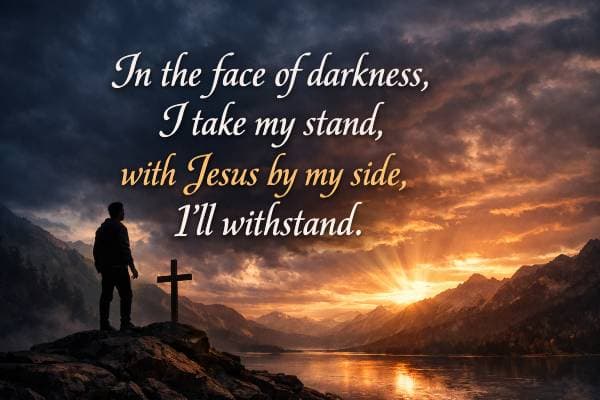
Updated September 11, 2026, by Catherine Pulsifer.
In the face of darkness, I take my stand,
With Jesus by my side, I'll withstand.
For Satan's temptations, they come my way,
But I choose to follow Jesus each day.
His light guides me through the darkest night,
Filling my soul with His love so bright.
Though the world may try to lead me astray,
I'll stand tall for God, come what may.
In a world of selfishness and greed,
I'll follow Jesus and meet every need.
For His path is true, His ways are just,
In Him, I place my unwavering trust.
So let Satan's powers do what they will,
I know Jesus's love will prevail still.
I'll stand tall for God, His creation of each day,
And walk in His light every way.
This poem is about standing firm in faith with Jesus despite facing temptations and darkness. It emphasizes relying on Jesus' guidance and love to overcome challenges and resist worldly influences.
In a consumer-driven culture, Christians may face temptations to prioritize wealth, possessions, and status over spiritual values. The pressure to constantly pursue material success and keep up with societal standards can lead to a neglect of spiritual growth and service to others. For instance, Christians may find themselves caught up in purchasing luxury goods or accumulating wealth at the expense of generosity and compassion towards those in need.
With the prevalence of social media platforms and digital technologies, Christians may encounter distractions that divert their attention from their faith. The constant bombardment of information, entertainment, and social interactions online can consume valuable time and energy, leaving little room for prayer, Bible study, and fellowship with other believers. For example, a Christian might spend hours scrolling through social media feeds, indulging in gossip, comparison, and frivolous content, rather than investing in spiritual disciplines and meaningful relationships.
In a secular society that promotes individualism and moral relativism, (moral relativism is the belief that moral principles are not absolute and unchanging, but rather dependent on individual or cultural perspectives, circumstances, or preferences.) Christians may face intellectual challenges to their beliefs and values. The rejection of absolute truth and the acceptance of subjective morality can undermine the authority of Scripture and the teachings of the Church. For instance, a Christian college student may encounter professors or peers who espouse secular ideologies and question the relevance of biblical principles in modern life, leading to doubts and confusion about their faith.
This theory proposes that life on Earth evolved over millions of years through natural processes. This challenges Christian beliefs in creation, particularly those who interpret the creation account in the Bible literally. The idea that humans and other species share a common ancestry conflicts with the traditional understanding of creation as a deliberate act of divine intervention. Furthermore, evolutionary theory suggests that humans are not inherently distinct from other animals, potentially undermining the belief that humans are created in the image of God. Consequently, some Christians may reinterpret or reject aspects of the creation narrative in the Bible in light of evolutionary theory, leading to a divergence from traditional beliefs in a literal six-day creation.
In regions where Christianity is a minority or faces opposition, believers may endure persecution and discrimination for their faith. This can manifest in various forms, such as social ostracism, legal restrictions, or physical violence. For example, a Christian living in a totalitarian regime may face imprisonment or torture for openly practicing their faith or sharing the Gospel with others.
These examples illustrate the diverse temptations and challenges that Christians encounter today, highlighting the importance of remaining steadfast in faith, prayer, and reliance on God's strength to overcome these obstacles and uphold the principles of their belief.
Continue exploring poems and quotes that encourage us to follow Jesus, trust God, and remain strong in our faith.

The poem Stand Always For God reminds us that faith is a daily choice, especially when challenges and distractions surround us. Standing for God does not mean life will be free of struggle, but it does mean we are never alone. With Jesus by our side, we find the strength to resist temptation, walk in truth, and live with purpose.
As you reflect on these words, may you feel encouraged to remain steadfast in your faith and confident in God’s guidance. When we choose to stand for Him, even in difficult moments, we experience His light, love, and peace leading us forward each day.
More Christian Poems to Encourage and Inspire