Popular Poem Categories:
Occasion & Holiday Poems:
This page shares the lesson in the poem I Can’t and I Can, reminding us that our attitude helps shape our days.
In I Can’t and I Can, William Allen Butler uses clear and memorable images to show the difference between doubt and determination. Through the characters of “I Can’t” and “I Can,” the poem brings to life the inner voices we all face when challenges appear. One voice weakens us with fear and excuses, while the other strengthens us with courage and steady effort.
As you read through this page, you will see how Butler’s message still applies today. The poem encourages us to recognize the power of our thoughts and the words we speak to ourselves. When we choose an “I Can” attitude, we open the door to growth, perseverance, and hope. This timeless poem reminds us that progress often begins with a simple but confident belief that we can move forward, one step at a time.
Updated August 28, 2026, by Catherine Pulsifer.
As on through life's journey we go day by day,
There are two whom we meet, at each turn of the way,
To help or to hinder, to bless or to ban,
And the names of these two are "I Can't" and "I Can."
"I Can't" is a dwarf, a poor, pale, puny imp,
His eyes are half blind, and his walk is a limp;
He stumbles and falls, or lies writhing with fear,
Though dangers are distant and succor is near.
"I Can" is a giant; unbending he stands;
There is strength in his arms and skill in his hands;
He asks for no favors; he wants but a share
Where labor is honest and wages are fair.
"I Can't" is a sluggard, too lazy to work;
From duty he shrinks, every task he will shirk;
No bread on his board and no meal in his bag;
His house is a ruin, his coat is a rag.
"I Can" is a worker; he tills the broad fields,
And digs from the earth all the wealth which it yields;
The hum of his spindles begins with the light,
And the fires of his forges are blazing all night.
"I Can't" is a coward, half fainting with fright;
At the first thought of peril he slinks out of sight;
Skulks and hides till the noise of the battle is past,
Or sells his best friends, and turns traitor at last.
"I Can" is a hero, the first in the field;
Though others may falter, he never will yield;
He makes the long marches, he deals the last blow,
His charge is the whirlwind that scatters the foe.
How grandly and nobly he stands to his trust,
When, roused at the call of a cause that is just,
He weds his strong will to the valor of youth,
And writes on his banner the watchword of Truth!
Then up and be doing! the day is not long;
Throw fear to the winds, be patient and strong!
Stand fast in your place, act your part like a man,
And, when duty calls, answer promptly, "I Can!"
I Can’t and I Can shows us two very different paths we can choose in life. One path is shaped by fear, excuses, and doubt. The other is guided by effort, courage, and hope. Through simple but strong images, the poem reminds us that our attitude often determines how far we will go.
When we choose the voice of “I Can,” we begin to move forward, even when the road feels difficult. The poem encourages us to believe in growth, to keep trying, and to trust that steady effort can lead to meaningful change. It is a reminder that progress often begins with the choice to believe we can take the next step.
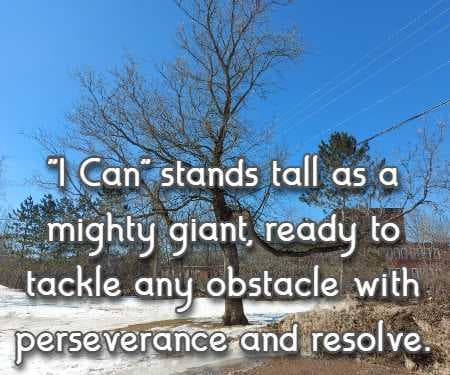
The message of I Can’t and I Can speaks to everyday life in a simple but powerful way. Each day we face choices that test our attitude. When we choose an “I Can” mindset, we become more willing to try, to learn, and to keep going even when progress feels slow.
An “I Can” attitude encourages us to take responsibility for our actions. It helps us set goals, make plans, and move forward one step at a time. Even small efforts, when done consistently, can lead to meaningful change and steady growth.
On the other hand, an “I Can’t” mindset often keeps us stuck. It focuses on fear, past mistakes, and what feels impossible. When we allow this voice to lead, we may delay action or give up too quickly. The poem gently reminds us that we are not meant to live this way.
By choosing an “I Can” approach, we open the door to new opportunities. We begin to see challenges as chances to grow rather than reasons to stop. This simple shift in thinking can bring greater confidence, stronger perseverance, and a deeper sense of purpose in our daily lives.
"To help or to hinder, to bless or to ban, and the names of these two are “I Can’t” and “I Can."
"Then up and be doing! the day is not long; throw fear to the winds, be patient and strong!"
"'I Can' is a hero, the first in the field; though others may falter, he never will yield."
William Allen Butler was an American author, poet, and lawyer who lived during the nineteenth century. Born on February 20, 1825, he used his writing to encourage strong character, personal responsibility, and steady effort in daily life.
Although much has changed since Butler’s time, the message found in I Can’t and I Can remains just as meaningful today. His words continue to inspire readers to choose courage over fear and action over doubt. Through his poetry, Butler left behind a lasting reminder that attitude and determination play an important role in shaping the direction of our lives.
This poem is structured as a contrast between two opposing characters "I Can" and "I Can't." The poem's form is predominantly narrative, using vivid imagery and direct language to portray the characteristics and actions of these two personas.
The poem employs a rhythmic and rhyming scheme, with an AABB rhyme scheme in each stanza. This consistent rhyme scheme helps maintain the poem's flow and adds to its readability and memorability.
Each stanza presents a new aspect of the contrast between "I Can't" and "I Can," illustrating their differences in terms of work ethic, courage, and determination.

The poem I Can’t and I Can leaves us with a simple but lasting reminder that the words we choose within ourselves shape the path we walk. William Allen Butler shows us that doubt can hold us back, but belief paired with effort can move us forward. Each day brings moments where we must decide which voice to listen to.
As you reflect on this poem, may it encourage you to answer life’s challenges with confidence and perseverance. When you choose an I Can attitude, even small steps can lead to meaningful progress. Let this poem inspire you to act with courage, believe in what you are capable of, and keep moving ahead with hope and purpose.
More Poems Of Encouragement to Inspire & Encourage