Popular Poem Categories:
Occasion & Holiday Poems:
Think about this question: Who do you work for? Many times when we have a boss, we think we work for them. But do we? As you read the poem, you may discover that the answer is very different from what you first expected.
While there are many poems about work, you will find that Edgar A. Guest has a way of writing poems that make us stop and think. His words encourage us to think about our own attitude toward work and the choices we make each day. So after reading his poem, answer the question, who do you work for?
Updated July 25, 2026, by Catherine Pulsifer.
I work for someone else, he said;
"I have no chance to get ahead.
At night I leave the job behind;
At morn I face the same old grind.
And everything I do by day
Just brings to me the same old pay.
While I am here I cannot see
The semblance of a chance for me."
I asked another how he viewed
The occupation he pursued.
It's dull and dreary toil, said he,
"And brings but small reward to me.
My boss gets all the profits fine
That I believe are rightly mine.
My life's monotonously grim
Because I'm forced to work for him."
I stopped a third young man to ask
His attitude towards his task.
A cheerful smile lit up his face;
I shan't be always in this place,
He said, "because some distant day
A better job will come my way."
Your boss? I asked, and answered he:
"I'm going to make him notice me.
He pays me wages and in turn"
That money I am here to earn,
But I don't work for him alone;
Allegiance to myself I own.
I do not do my best because
It gets me favors or applause--
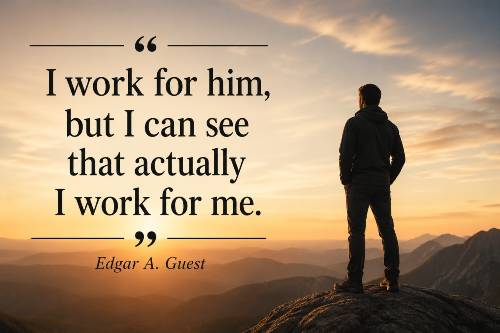
I work for him, but I can see
That actually I work for me.
"It looks like business good to me
The best clerk on the staff to be.
If customers approve my style
And like my manner and my smile
I help the firm to get the pelf,
But what is more I help myself.
From one big thought I'm never free:
That every day I work for me."
Oh, youth, thought I, you're bound to climb
The ladder of success in time.
Too many self-impose the cross
Of daily working for a boss,
Forgetting that in failing him
It is their own stars that they dim.
And when real service they refuse
They are the ones who really lose.
This poem teaches that work is not only about wages, a boss, or a daily task. It is also about the kind of person we become through our effort. When we work with a willing attitude, give honest service, and take pride in what we do, we are building our own character and future.
Take a moment to explore more poems and quotes that encourage, inspire, and remind you to give your best each day.





This poem reminds us that while we may have a boss or a job, our effort truly belongs to us. The attitude we bring to our work, the pride we take in what we do, and the effort we give each day all shape our future. When we do our best, not just for others but for ourselves, we open the door to growth and new opportunities.
No matter where you are in your work or life, remember that every task is an opportunity to grow, learn, and become the best version of yourself. When you choose to give your best each day, you are investing in your own future and building a life you can be proud of.
More Edgar A. Guest Poems
"The biggest job we have is to make the most of what we are given."
Edgar A. Guest