Popular Poem Categories:
Occasion & Holiday Poems:
What is man, and where do his abilities, achievements, and strength truly come from? In this thought-provoking poem, Arthur Franklin Fuller reflects on human nature as he watches people passing by and considers the different desires and ambitions that guide their lives.
Fuller observes pride, selfishness, the pursuit of power, and the tendency to become so caught up in worldly concerns that we forget what is right. Yet his message is not simply a criticism of human behavior. He points us toward humility and reminds us that our talents, thoughts, and abilities are gifts from God.
As you read What Is Man, consider Fuller's reminder that no matter how successful or powerful we may become, we still depend upon God's grace. His words encourage us to live with humility, recognize where our blessings come from, and remember that character matters more than pride.
Updated September 21, 2026, by Catherine Pulsifer.
I sat me down by the wayside
To watch the passing throng
And guess at the varied interests
That moved each one along.
I saw the young and simple
Who flirt in wanton glee -
The hurrying man of business
As serious as could be.
I sat me down by the wayside
To note the crowd and din,
Where haste keeps ever silent
The still, small voice within;
For minds that brim with conquest
Forget what is right and wrong -
And hearts that seethe with lustings.
Unreasoning, drift along.
Behold th' approaching master!
With pompous ways supreme -
Perhaps he's just created
A Universe, I ween!
Now, what is God beside him
Who struts so proud and chill -
Omnipotence is nothing
When one has Power to Will!
O vaunting, crumbling castle,
O sod that stalks so fine -
Where didst thou get thy power,
Thy intellect sublime?
Well friend, just let me tell thee
A Truth that thou shouldst know -
Thou mayst be wise and mighty,
But such had e'en to grow.
Now listen, self-fooled debtor,
And learn this lesson well -
There's nothing so important
As keeping out of hell;
Too late thou mayst discover
Some laws must honored be -
No man has e'er escaped them
To this thou must agree.
No thing was e'er created
By man, and man alone -
The very thought thou thinkest,
God gives thee now to own;
Conception is receiving
And fostering, law on law,
The thought which God created
And full fruition saw.
All Power that was, or is, sir,
Or may seem given birth,
Comes straight from God Almighty,
Be it in heav'n or earth;
Then be not quite so haughty.
But choose a lowly place -
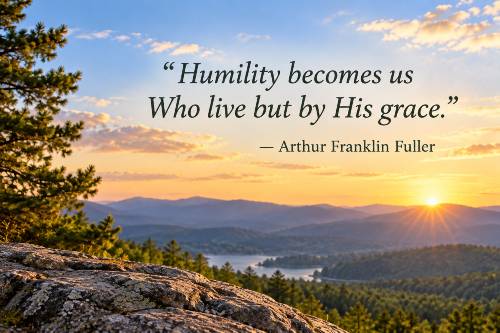
Humility becomes us
Who live but by His grace.
Fuller watches people hurrying through life with their minds focused on business, pleasure, and personal desires. His words remind us not to become so busy that we lose sight of what is right and important.
Success and power can make a person feel more important than they truly are. The poem encourages us to remember that our achievements do not make us independent of God or others.
Fuller challenges the idea that people accomplish everything through their own strength. He reminds us that our ability to think, create, and achieve is something for which we can be thankful.
The poem reminds us that there are principles of right and wrong that cannot simply be ignored. How we choose to live and treat others matters.
The closing lines point us away from pride and toward humility. Recognizing our dependence upon God's grace can help us live with gratitude rather than self-importance.
Continue exploring thoughtful poems that ask meaningful questions about love, family, faith, and the things that matter in life.


Arthur Franklin Fuller's poem leaves us with a question worth considering long after we finish reading. What makes a person truly important? His answer points us away from pride, status, and worldly power and toward humility, faith, and an understanding of where our abilities and blessings come from.
We may accomplish many things during our lives, but Fuller's words remind us not to lose sight of God in the process. When we recognize that our strength, opportunities, and abilities are gifts, there is less room for pride and more room for gratitude. May this poem encourage us to walk through life with a humble heart and an appreciation for the grace that sustains us.
More Famous Christian Poems to Inspire