Popular Poem Categories:
Occasion & Holiday Poems:
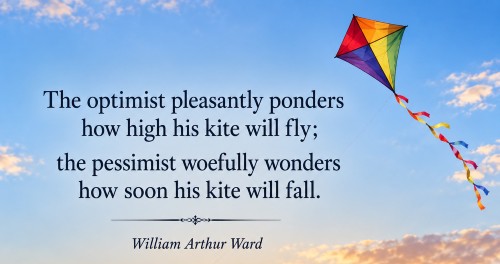
Much has been written about pessimists and optimists, and few writers explain the difference as clearly and simply as William Arthur Ward.
Our outlook on life shapes how we respond to everyday situations, challenges, and opportunities. Two people can face the same problem, yet see it in very different ways. One may focus on what is wrong, while the other looks for what can be learned or improved. This difference in attitude often determines whether we feel discouraged or hopeful.
In this thoughtful poem, William Arthur Ward clearly shows how a pessimist and an optimist approach life. Line by line, he contrasts fault finding with solution seeking, complaining with encouragement, and fear with confidence. His words invite us to pause and consider how we respond when things do not go as planned.
Optimism does not mean ignoring difficulties. It means choosing to believe that effort matters and that positive action can bring change. Life tends to feel lighter and more fulfilling when we look forward with hope instead of dwelling on setbacks. May these words encourage you to reflect on your own outlook and choose a more optimistic way of seeing the days ahead.
Updated September 16, 2026, by Catherine Pulsifer.
The pessimist finds fault;
The optimist discovers a remedy.
The pessimist seeks sympathy;
The optimist spreads cheer.
The pessimist criticizes circumstances;
The optimist changes conditions.
The pessimist complains about the apple seeds;
The optimist plants them.
The pessimist imagines impending peril;
The optimist sees signs of prosperity.
The pessimist disparages;
The optimist encourages.
The pessimist creates loneliness;
The optimist finds friends.
The pessimist nibbles at the negative;
The optimist is nourished by the positive.
The pessimist builds barriers;
The optimist removes roadblocks.
The pessimist invents trouble;
The optimist enriches the environment.
Mr. Ward has a way of writing that makes us stop and reflect on our attitude. Are we optimistic, or do we lean toward pessimism? May his words encourage us to look at life with hope and a positive outlook.
To the optimist, obstacles are challenges,
Roadblocks are inspirations,
And problems are invitations to achievement.
An optimist is a person who undertakes a seemingly impossible task
in a spirit of immeasurable enthusiasm,
unbounded determination, unbelievable excitement, indestructible confidence,
uncompromising thoroughness, and indefatigable persistence...
with understandable success.
The pessimist fears a future of futility;
The optimist fills the present with purpose,
Optimism is a sidewalk word for faith.
The optimist believes
In joy, not in gloom,
In smiles, not frowns;
In answers, not excuses.
Optimism is
Psychological sunshine,
Mental vitamins,
And spiritual oxygen.
The doormat to the pessimist
Is a welcome mat to the optimist.
We become as pessimistic as our anxieties,
or as optimistic as our affirmations.
The optimist believes that God is good, the universe is friendly,
and humanity is worth saving.
The optimist lives on the peninsula of infinite possibilities;
The pessimist is stranded on the island of perpetual indecision.
Even when adversity has the bases loaded,
The optimist expects to win the game.
Optimism is a seed sown in the soil of faith;
pessimism is a seed hoarded in the vault of doubt.
Optimists enrich the present, enhance the future,
challenge the improbable, and attain the impossible.
We can start each day with
apprehension, or anticipation,
cynicism, or optimism;
apathy, or adventure.
Continue exploring poems and quotes that encourage optimism, perseverance, and a positive outlook on life.





William Arthur Ward reminds us that our outlook can influence how we respond to each day. Through simple contrasts, he shows how an optimistic attitude can affect our actions, our relationships, and the way we face challenges. Choosing to look for possibilities rather than problems can help us move forward with greater hope and purpose. May these words encourage you to approach each day with patience, confidence, and a willingness to see the good, even when life presents challenges.
More William Arthur Ward Poems to Motivate and Inspire