Popular Poem Categories:
Occasion & Holiday Poems:
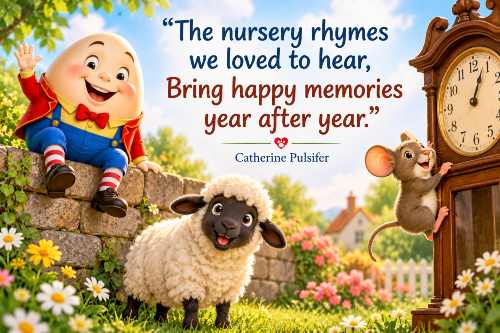
Popular nursery rhymes have been enjoyed by children for generations. From Humpty Dumpty and Jack and Jill to Hickory Dickory Dock, these familiar little poems bring smiles, laughter, and happy memories.
Many of us remember hearing these rhymes when we were children, and now we have the joy of sharing them with our own children and grandchildren. Their simple words, playful characters, and catchy rhythms make them fun to read aloud, sing, and memorize.
Long before nursery rhymes appeared in children's books, many were passed from one generation to another by word of mouth. Today, these traditional verses continue to be loved by children everywhere. Enjoy these 13 popular nursery rhymes and make some new memories together!
Updated October 20, 2026, by Catherine Pulsifer.
Some nursery rhymes never seem to grow old. Their familiar words and simple rhythms make them favourites with young children. These classic rhymes are wonderful for reading aloud, practising memory skills, and sharing a little laughter together.
"Baa baa, black sheep,
Have you any wool?"
"Yes sir, yes sir,
Three bags full.
One for my master,
One for my dame,
And one for the little boy
Who lives down the lane."
Hickory dickory dock,
The mouse ran up the clock.
The clock struck one,
The mouse ran down,
Hickory dickory dock.
Little boy blue,
Come blow your horn,
The sheep's in the meadow,
The cow's in the corn.
But where is the boy
Who looks after the sheep?
He's under a haystack,
Fast asleep.
Will you wake him?
No, not I
For if I do
He's sure to cry.
Children love rhymes that make them laugh and use their imagination. From a cow jumping over the moon to a bear without any hair, these playful nursery rhymes are full of silly surprises and memorable characters.
Hey, diddle, diddle,
The cat and the fiddle,
The cow jumped over the moon;
The little dog laughed
To see such sport,
And the dish ran away with the spoon.
Incy Wincy spider climbing up the spout
Down came the rain and washed the spider out
Out came the sunshine and dried up all the rain
And Incy Wincy spider climbed up the spout again
Fuzzy Wuzzy
Was a bear,
Fuzzy Wuzzy
Had no hair,
Fuzzy Wuzzy
Wasn't really fuzzy,
Wuzzy?
Some of the best known nursery rhymes tell short stories about characters who find themselves in funny or unexpected situations. Children enjoy following these little adventures and often remember the words long after hearing them for the first time.
Humpty Dumpty sat on a wall,
Humpty Dumpty had a great fall;
All the king's horses and all the king's men
Couldn't put Humpty together again.
Jack and Jill went up the hill
To fetch a pail of water;
Jack fell down and broke his crown,
and Jill came tumbling after.
Up Jack got, and home did trot,
As fast as he could caper,
To old Dame Dob, who patched his nob
With vinegar and brown paper.
Little Miss Muffet
Sat on a tuffet,
Eating of curds and whey;
There came a big spider,
And sat down beside her,
And frightened Miss Muffet away.
Nursery rhymes are even more fun when children can clap their hands, move along with the words, or join in with a familiar verse. These last four rhymes are wonderful for encouraging children to participate, sing, and enjoy poetry through play.
Pat a cake, Pat a cake, baker's man,
Bake me a cake as fast as you can;
Pat it and prick it and mark it with a 'B',
And put it in the oven for Baby and me,
For baby and me,
For baby and me,
Put it in the oven for Baby and me.
Jack Sprat could eat no fat,
His wife could eat no lean;
And so betwixt them both,
They lick'd the platter clean.
Little Jack Horner
Sat in the corner,
Eating of Christmas pie:
He put in his thumb,
And pulled out a plum,
And said, "What a good boy am I!"
Head, shoulders, knees and toes, knees and toes
Head, shoulders, knees and toes, knees and toes
And eyes and ears and mouth and nose
Head, shoulders, knees and toes, knees and toes
Explore more poems and quotes that celebrate children, childhood memories, and the joy of watching little ones grow.
Celebrate the excitement of childhood and the many changes children experience with our poem The First Steps.
Find inspiring and thoughtful words about the happiness children bring into our lives in our collection of Children Quotes.
Enjoy poems about the wonder, laughter, and precious moments of childhood in our Poems About Children.
Share the excitement of the Christmas season with young readers through our collection of Children's Christmas Poems.
Popular nursery rhymes have a special place in childhood. Their playful words, familiar characters, and simple rhythms have entertained children for generations. Even though times have changed, these little poems continue to bring the same smiles and laughter they did years ago.
Whether you are reading to a young child, teaching a rhyme to a grandchild, or remembering the verses you learned long ago, nursery rhymes offer a wonderful way to spend time together. They encourage imagination, language development, and a love of poetry.
So choose a favourite rhyme, read it aloud, and enjoy the fun of saying the words together. The memories you create today may become the very rhymes your children share with their own families someday.
More Poems For Kids to Encourage and Inspire