Popular Poem Categories:
Occasion & Holiday Poems:
Have you ever been so frustrated by a decision at work that you wanted to speak your mind right away? When emotions are running high, it can be easy to say something we later wish we had handled differently.
In Journaling Work Issues, Byron Pulsifer shares a personal experience that taught him the value of writing down his frustrations before responding. His story, along with the poem Write Before You Speak, reminds us that taking time to think can reduce stress and help us communicate more wisely.
Updated October 19, 2026, by Catherine Pulsifer.
By Byron Pulsifer, © 2003
I don't know about you, but every so often I used to get really aggravated about a less than brilliant idea or policy at work.
Sometimes I just couldn't believe how utterly ridiculous some decisions coming from senior staff seemed to be. Not being one to sit back and let things slide, I constantly got myself into hot water by speaking my mind. Deep down, I knew I was creating problems for myself.
To make matters worse, someone else would often raise the very same issue in a much calmer and more reasoned way and receive praise for bringing it to management's attention. How annoying! Would I ever learn?
I knew there had to be a better way to control my impulse to speak too quickly and forcefully. I wanted to get my point across and encourage positive change without getting myself into trouble.
Late one Friday afternoon, an email arrived announcing another policy decision that sent me for a loop. I knew I wanted to make a case for changing it, but it was too late in the day to speak with the person responsible.
Not wanting to lose my momentum, I sat down at my computer and wrote everything that was on my mind. I held nothing back. I didn't worry about anyone's feelings or whether my words were diplomatic.
I spelled out exactly what I thought should be done and why the policy seemed to violate every reasonable thought process. By the time I finished pounding away at my keyboard, I had written a scathing rebuttal of more than five pages.
Fortunately, instead of sending it, I printed the document and put it in my desk for safekeeping, planning to retrieve it first thing Monday morning.
It had taken me about forty-five minutes to write. When I finished, I felt much calmer and more relaxed. I was glad to have gotten the issue off my mind.
I had a great weekend. Work issues were no longer festering in the back of my mind or interfering with the things I wanted to enjoy.
When I returned to work Monday morning, I was ready to pick up where I had left off. But then something unexpected happened. I took the document from my desk and read it carefully.
I was flabbergasted. If I had presented that document as written, I probably wouldn't have had to worry about work anymore. I could have been fired on the spot!
That experience taught me a valuable lesson and gave me a practical way to keep my frustration and stress in check.
The technique is simple: write down what is bothering you, privately and without editing yourself. Giving your feelings a place on paper can help you release some of the tension instead of directing it at someone else.
That technique is called journaling.
When something at work upsets you, write down what you feel without trying to make every sentence polite or perfect. Keep those thoughts private, set them aside for at least twenty-four hours, and then read them again.
In my case, I rewrote my document using reasonable arguments, rational thought, and professional, diplomatic language. I could still address the problem, but in a way that was much more likely to be heard.
Try this technique the next time frustration gets the better of you. You may find that journaling helps you relieve stress, respond more wisely, and even keep your job.
There are days when work is trying,
When decisions make no sense,
And we feel the need to speak our mind,
Without a thought of consequence.
But words we speak in anger
Can cause more harm than good,
And often leave us wishing
We had taken time to understand.
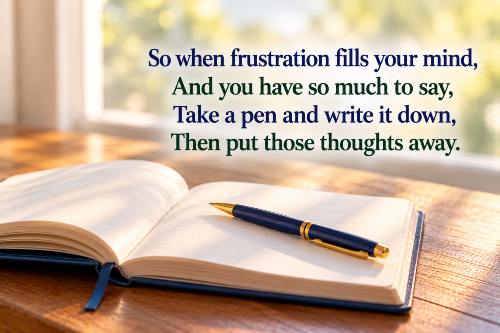
So when frustration fills your mind,
And you have so much to say,
Take a pen and write it down,
Then put those thoughts away.
Let the hours bring perspective,
Let your anger disappear,
For what seemed so important yesterday
May look much different when thoughts are clear.
Then read the words you have written,
And consider what is true,
Choose a calm and thoughtful answer,
Before deciding what to do.
For writing helps release the stress,
And gives your mind a chance to rest,
A thoughtful word, a patient heart,
Can often bring about the best.
Speaking while angry can make a difficult situation worse. Give yourself time to think before sharing your concerns.
A private journal can be a safe place to express frustration. Putting your thoughts into words may help you feel calmer.
What feels urgent in the moment may look different the next day. Waiting before responding can help you see the situation more clearly.
A respectful, thoughtful message is more likely to be heard. You can disagree with a decision without letting anger lead the conversation.
Journaling is not just about letting off steam. It can help you decide what needs to change and how to approach the problem constructively.
Find more poems and quotes about handling frustration, reducing stress, and approaching life's challenges with a positive attitude.



Workplace frustrations are part of life, but they do not have to control the way we respond. As Byron Pulsifer discovered, writing down our feelings can help us release some of the anger and avoid saying something we might regret.
The next time a decision at work leaves you upset, try putting your thoughts on paper and waiting until the following day to read them. You may discover that the problem still deserves attention, but that a calmer approach will help you make your point more effectively.
Sometimes the wisest words are the ones we take time to consider before we speak.
More Positive Messages to Encourage