Popular Poem Categories:
Occasion & Holiday Poems:
Being grateful and thankful can make a difference in how we see our lives. It is easy to focus on what is going wrong, what we do not have, or what we wish were different. Yet when we stop and appreciate the good things already around us, our outlook can begin to change.
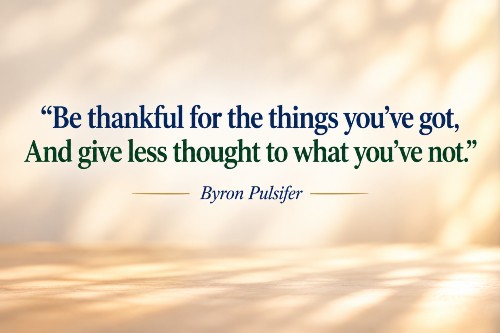
In this positive thought, Byron Pulsifer reminds us that gratitude is not about having a perfect life. It is about recognizing the people, opportunities, and everyday blessings we sometimes overlook. Along with his message, the poem Count What You Have encourages us to spend less time complaining and more time appreciating what we have.
Updated October 19, 2026, by Catherine Pulsifer.
By Byron Pulsifer, © 2007
How many times have you heard these words without really realizing that they directly relate to you? How many times have you moaned and complained that your life, work, or relationships are the pits? How many times have you created your own stress?
Like many people, we often spend far too much time focusing on the problems we think we have rather than appreciating what we do have.
You don't have to look very far to notice that someone else is facing difficult circumstances. It could be a family member, friend, colleague, or neighbour. Every day we hear stories about people dealing with illness, loss, financial hardship, or other challenges. These difficulties are not limited to people living in distant places. They can affect people in our own communities.
One of the saddest ways to go through life is believing that the world is against you. I call this the "poor me" syndrome.
You may feel that your relationships are in disarray or that you are suffering work stress because of the way others treat you. Perhaps you feel that you are the most unpopular employee in your department or that your boss is always picking on you.
While some problems are real and need to be addressed, constantly focusing on what is wrong can make an already difficult situation feel even more stressful.
Let's look at the opposite side of the coin. Instead of spending all your time thinking about what you don't have, what you would like to be, or the relationships you wish were different, take a moment to examine what you do have.
Consider some of the everyday things we may take for granted:
Even something as simple as being able to read this message is worth appreciating. Whether you are using your own computer, visiting a library, or borrowing a device from a friend, you have an opportunity to learn, reflect, and discover new ideas.
The purpose of these comparisons is not to dismiss the difficulties you may be facing. It is to remind us that even during challenging times, there may still be things in our lives for which we can be thankful.
The point is simply this: express your gratitude to your friends for being there. Let people know how much you appreciate their kindness, encouragement, and support.
Be grateful for what you have, even though it may not be everything you want. Be thankful for the freedom to change, to learn, to make progress, and to improve your circumstances by looking for solutions rather than seeing only problems.
Don't create additional stress for yourself by allowing every little thing to upset you. Instead, take time to recognize what is good in your life. Gratitude may not remove every difficulty, but it can help you approach those difficulties with a more positive outlook.
How often do we stop and say,
I'm thankful for the gifts today?
Or do we spend our precious time,
Complaining when life's not sublime?
We think about the things we lack,
The troubles that may hold us back.
Yet seldom do we stop to see,
The blessings given you and me.
A job to do, a friend who cares,
A home to live in, someone who shares.
The chance to learn, the choice to grow,
Are gifts we often overlook, you know.
There will be days when things go wrong,
When worries seem to last too long.
But dwelling on what isn't right,
Can hide the good that's in our sight.
So rather than complain today,
Look for a better, wiser way.
Be thankful for the things you've got,
And give less thought to what you've not.
For gratitude can change your view,
And help you see what you can do.
The more you count your blessings each day,
The less your worries stand in the way.
It is easy to spend time wishing for things we do not have. When we stop and recognize the good already in our lives, we often discover there is more to appreciate than we realized.
Being thankful does not mean that every problem disappears. It means choosing to recognize the good alongside the difficulties we face.
Constantly thinking about what is wrong can add to our stress. Looking for solutions and appreciating what is going right can help us approach problems more calmly.
Friends, family, and those who offer encouragement are blessings we sometimes take for granted. A simple thank you can remind them how much their kindness means.
We do not need expensive possessions or a perfect life to find reasons for gratitude. Often it is the simple things, such as a kind word, a place to call home, or an opportunity to learn, that matter most.
Explore more poems and quotes about gratitude, appreciation, thankfulness, and finding encouragement in the blessings of everyday life.



Gratitude is not about pretending that life is perfect or ignoring the problems we face. It is about remembering that even when things are difficult, there may still be something good worth appreciating. A caring friend, a helping hand, or the opportunity to begin again can give us reasons to be thankful.
Byron Pulsifer's message and the poem Count What You Have remind us that our thoughts can influence how we experience each day. When we spend less time dwelling on what we lack and more time appreciating what we have, we may find that our worries become easier to manage.
Take a moment today to count your blessings, thank someone who has made a difference in your life, and remember that gratitude often begins with the simplest things.
More Positive Messages