Popular Poem Categories:
Occasion & Holiday Poems:
Job burnout can leave you feeling exhausted, discouraged, and wondering if all your hard work is worth it. When stress becomes part of your everyday routine, it is important to recognize the warning signs and find ways to restore balance in your life.
These five ways to combat job burnout, shared by career coach Krista Regedanz, offer practical steps to help you reduce stress, protect your energy, and rediscover what matters most. Along with her advice, you will find an encouraging poem about finding balance between work and life.
Updated October 19, 2026, by Catherine Pulsifer.
Author: Krista Regedanz
The challenge of burnout can be especially taxing for creative, goal-oriented people. When these people blame themselves for their situation, the feeling of exhaustion only gets worse, and they feel helpless. Their efforts seem to get them nowhere.
The cycle of working harder, seeing little or no results and getting increasingly stressed out is extremely disparaging.
As a career coach specializing in helping people through this exhausting cycle, I've found tools that help combat burnout. If you suffer from burnout, applying these tools will help you increase your energy and incrementally take your life back from your draining job.
An emergency escape route takes some of the paralyzing stress from you. You facilitate the planning for your next step. Some first steps in creating your escape route are: find ways to create a money reserve and prepare a current resume.
Environments are the circumstances, objects, or conditions which surround you. An environment can be your eNetwork (email, web, electronic community) or your vocabulary.
You can increase your creativity and inspiration by setting up supportive environments that constantly trigger inspiration. If your morning drive to the office finds you discouraged by listening to negative morning news, consider creating a new environment by listening to your favorite music or to inspirational talks.
A drain is anything that wastes your time, drains your energy, and has some negativity around it. It could be circumstances, habits, things or people.
Drains have an opportunity cost. When you focus on a drain, you don't have time to create, respond to opportunities (or even notice them), or do what you really want. You miss out on opportunities which might be more fun, lucrative, creative or significant.
Your values are the behavior and activities to which you are naturally drawn. When engaged in these activities, you feel most like yourself: connected, excited, glowing. Your life has a feeling of effortlessness. Most of us lead lives which do not grant us the chance to feel this way. If you take the time to identify your values, you will be more aware of why there are conflicts between you and your job and be more able to identify the needs you have sacrificed.
Until you take the time to define success for yourself, it will be defined by others (your boss, your parents, your partner), your culture, the past, or advertising. One way to define success for yourself is to complete the sentence, "I know I am being successful by . . ."
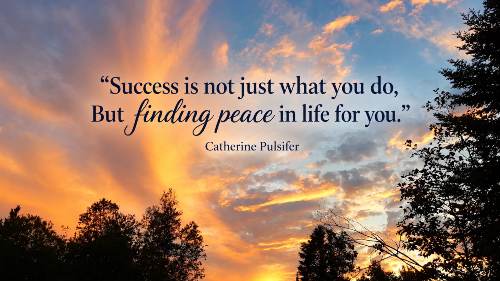
Sometimes a few encouraging words can remind us that there is more to life than work and responsibilities. This poem by Catherine Pulsifer encourages us to recognize when we need a break, let go of unnecessary stress, and remember that success includes peace of mind and personal happiness.
When work becomes a heavy load,
And stress seems endless on life's road,
Take time to rest, to pause, to see,
The life you live is yours to be.
Let go of things that drain your day,
Find those who help you on your way.
Remember what brings joy to you,
And make some time for those things too.
Success is not just what you do,
But finding peace in life for you.
So take small steps, let balance grow,
A happier path you'll come to know.
Find more encouraging poems and quotes about work, success, motivation, and creating a life with less stress.
When responsibilities seem endless, our Success Poems offer encouragement to keep moving forward while remembering what true success means.
Discover thoughtful reminders about work, effort, and personal fulfillment in our Poems About Work.
Find the inspiration to face challenges and stay focused on your goals with our Motivational Poems.
Job burnout does not usually happen overnight. It often develops when we continue pushing ourselves without taking time to rest, reflect, or consider what we truly need. The good news is that small changes can make a difference.
As Krista Regedanz reminds us, creating a plan, surrounding ourselves with positive influences, removing unnecessary stress, and understanding our personal values can help us move toward a more satisfying working life.
Remember, your job is only one part of your life. Your health, family, happiness, and peace of mind matter too. You do not have to measure your worth by how much you accomplish each day. Sometimes the most important step toward success is giving yourself permission to slow down and enjoy the life you are working so hard to build.
More Positive Thoughts