Popular Poem Categories:
Occasion & Holiday Poems:
Does the thought of standing in front of a crowd and giving a holiday speech make you nervous? You're not alone. Whether you're speaking at an office Christmas party, a holiday gathering, or a special celebration, public speaking can bring on stress, even for those who are usually confident.
The good news is that preparation can make a difference. In this positive thought, Byron Pulsifer shares ten practical tips to help you prepare for a holiday speech, calm your nerves, and speak with greater confidence. You'll also find an encouraging poem to remind you that a little nervousness is nothing to fear.
Updated October 20, 2026, by Catherine Pulsifer.
By Byron Pulsifer, © 2006
Dry mouth, shaking knees, headache, and perspiring profusely. Does this sound familiar? From hundreds of interviews, I've found that being asked to give a speech is one of the greatest stressors at work.
Depending on your work environment, however, you probably can't avoid making that holiday address to your co-workers, or employees forever. So, how do you handle this stressful situation?
Some people would have you believe that all you have to do is pretend that your audience isn't there, or to pretend that you're talking to a group of first graders. Nothing can be further from the truth.
In the simplest of terms, giving a speech requires preparation, lots of it especially if this is your first speech. Very few of us, unless we're experienced public speakers, can wing it off the top. And, even if you can wing it, it's probably because you're talking about something you've either talked about before, or you are able to grab snippets of information from other addresses.
Let's assume you are asked to make a few remarks for a pre-holiday get together and dance. Here are a few nifty tips to help you make it through that first holiday speech:
After all, you're not there to campaign for public office. All you need is a few paragraphs that:
Don't skip a word. Write it so it is at least double-spaced so if you have to read portions (like people's names) you can easily find them on the page. It is also a good idea to use a coloured highlighter to mark their names so they are easy to see.
Once you have every word written, practice giving your address in private reading aloud. At this time, highlight (with a different colour than used for names) any words where you want to emphasize, pause, or significantly change your tone or loudness.
The idea here is to give yourself as many clues as possible so you won't forget them in the heat of the moment.
Remember preparation. You can never read your speech too often, or practice too many times. When I practiced in preparation to give a short seminar, I would rehearse the full seminar at least eight times.
The important point here is that you want to become so familiar with your speech that you could recite it word for word in your sleep. You want to make it good, don't you? So, practice, practice, and practice.
Obviously, I'm not talking about just rehearsing the night before, or two days before. I'm talking about at least two weeks before, especially if this is your first time. Give yourself ample time to feel totally at ease.
Another little trick that I used was to dress exactly the way I would for the event. This technique ensures that you are not only totally comfortable with what you are going to say, but totally comfortable physically as well.
If you have a spouse, partner, children, or a close friend, rehearse your speech in front of them. There is nothing like someone else watching your every move, listening to every word to give you that sense of "you're on" feeling.
If you are going to give your speech at the start of the event, refrain from caffeine (coffee, tea, coke) as these will exaggerate all the stress responses. If you are prone to perspiring, arrive early and make sure the heat is turned down a few degrees, or the air conditioning is on. If you can't do this, open any doors or windows.
And, here's another little trick I learned. Make sure you have water handy, and not cold water. Sip room temperature or warm water. This will keep your vocal cords relaxed.
Don't drink alcohol at least twenty-four hours before, and don't light that cigarette just before you give your speech. These will only make matters worse. Wait until you're finished.
And, last of all, take a few deep breaths before you start. Look for a friendly face to focus on when you start. I'm talking about somebody that is either smiling at you, or you know very well and feel totally comfortable with.
At the very least, focus on this person for your first few sentences, then let your gaze go to the back of the room. Try and speak to the left side, then centre and then right side of the room so you give the appearance that you are including everyone in your address.
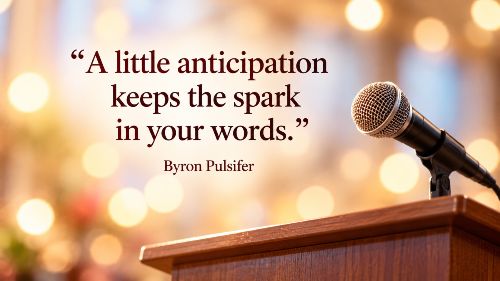
Even after all your practice, you're sure to have a few butterflies. This is good. A little anticipation keeps the spark in your words. Butterflies? You bet but the secret, from all your rehearsals, is that you can get the butterflies to fly in formation.
Feeling nervous before giving a speech is something many of us experience. But with practice, preparation, and a little confidence, those nervous feelings do not have to stop us. This poem by Catherine Pulsifer offers a lighthearted reminder that we don't have to be perfect speakers to make a positive impression.
Your knees may shake, your hands may sweat,
A speech to give, you're filled with fret.
But don't let fear get in your way,
Prepare yourself for that special day.
Write your words and practice well,
Let confidence replace fear's spell.
Keep it short, speak from the heart,
And you'll be ready when it's time to start.
Take a deep breath, let worries go,
Speak with a smile, let kindness show.
Those butterflies may still appear,
But preparation will calm your fear.
Remember, no one expects perfection,
Just honest words and warm connection.
So stand up tall and do your best,
Then enjoy the holiday with all the rest!
Find more encouraging poems and quotes about communication, confidence, motivation, and facing life's challenges.
Discover how words can strengthen understanding and relationships through our Communication Poems.
When you need a reminder to believe in yourself, our Motivational Quotes can offer a fresh perspective.
Sometimes just a few words can lift your spirits, as you'll discover in our Short Inspirational Quotes.
Enjoy thoughtful reminders about courage, hope, and a positive attitude in our Positive Poems.
Giving a holiday speech may never be your favourite part of the celebration, but it doesn't have to become a source of overwhelming stress. As Byron Pulsifer reminds us, preparation is one of the best ways to replace worry with confidence.
By keeping your message short, practising your words, and focusing on the people you are speaking to, you can turn a nervous moment into an opportunity to share appreciation and good wishes. Remember, your audience is not expecting perfection. They simply want to hear a sincere message.
So when it's your turn to speak, take a deep breath, smile, and trust the preparation you've done. Those butterflies may still be there, but with a little practice, you can help them fly in formation. And when your speech is finished, you can relax and enjoy the holiday celebration too!
More Positive Thoughts